
Rising global energy demand has significantly increased the transportation of crude oil via air, water, and land routes. Oil spillage and leakage occurring during transportation, processing, and through other human activities contaminate the terrestrial environment. Soil is the component of the terrestrial environment that is most impacted; the subsequent drop in agricultural output results in tremendous monetary losses.
We, as Enviro Janitors, have developed a system for converting polluted soil into fertile soil in-situ, using microbial breakdown of hydrocarbon oil from the contaminated soil.
We’ve also built an ex-situ Pyrolytic Soil Remediation Plant (PSRP) that can handle massive amounts of polluted soil.The method has the ability to provide rapid remediation while preserving soil fertility.
Patented Low cost In-situ technology for the Conversion of Contaminated Soil into Fertile soil by Microbial degradation of hydrocarbon oil from the contaminated soil
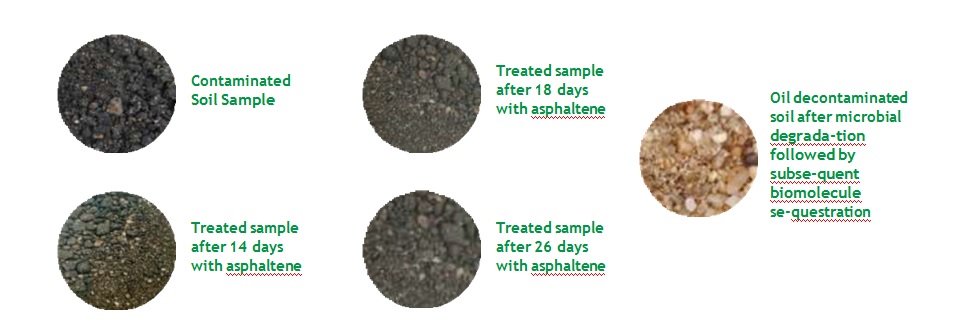
This technology involves the microbial degradation of hydrocarbon oil contaminated soil .The contaminated soil will be made into grids ( area of the grid will be based on time limit provided for decontamination ) .The microbial culture will be developed at the site and will be mixed with the soil along with the nutrients with periodic turn over of the soil.The retention time required will be 30 days.
The technology revolves around the novel culture isolated and deposited in the culture bank more specific for the degradation of hydrocarbon oil.The microbial culture , requires a specific moisture content , produces the varied enzymes in the first phase and biomolecules in the second phase utilising the hydrocarbon oil itself.The liberated biomolecule can dislodge the hydrocarbon oil and enzymes catalytically degrade the hydrocarbon oil into safe end products.
The biodegraded hydrocarbons will be removed by Heterotrophic bacteria in the third phase ultimately the “Contaminated soil will be converted into Fertile soil”
Important features of the technology:
- This is an in-situ method for the removal of hydrocarbon layer from the contaminated soil with excavation of grids one at a time method .
- The total time required to treat the contaminated soil in a grid will be around 30 days.
- The treatment process requires the consumable in terms of, electrical energy and plain water and nutrient chemicals for the production of novel culture at the site .
- The treatment process does not produce any secondary emissions during the course of degradation of oil from soil.
Advantages with the technology:
- This is a low cost technology
- This is a well proven patented technology
- The soil will be decontaminated without leaving any residual organics in the soil
- C/N ratio of the soil will be improved to the soil fertility value
- Consumption of water will be less
- No generation of liquid wastewater
- No odour emission during the conversion
- No emission of dust particulates during the conversion
- The transfer of technology will also be monitored by a national university and the service will be assured for the life cycle of the soil.
PYROLYTIC SOIL REMEDIATION PLANT (PSRP)
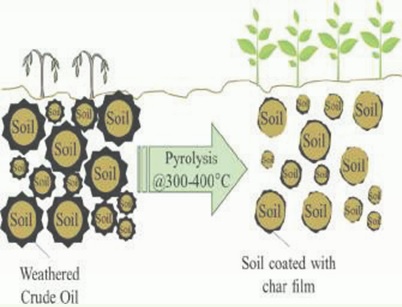
Pyrolytic remediation of crude oil-contaminated soil
While numerous remediation procedures have been developed to repair polluted soils, many of them are either marginally cost-effective or unfeasible when it comes to treating soils contaminated with heavy petroleum hydrocarbons.
Because aerobic bioremediation and natural attenuation are sluggish and can produce additional harmful byproducts (such as PAH derivatives), it’s impossible to accomplish regulatory cleaning targets without fully detoxifying the soil.
Furthermore, present direct firing technologies have the potential to severely harm important soil elements and deteriorate soil qualities such as water retention and stability.
As a result, polluted soils remediated with thermal treatments are frequently unable to support vegetation and must be utilised as backfill in building projects or disposed of in landfills.
As a result, using existing thermal remediation procedures, full ecosystem restoration of petroleum-contaminated locations is difficult to achieve.
Enviro Janitors developed the cutting-edge Pyrolytic Soil Remediation (PSR) System, which can restore the agricultural value of polluted soils while also assisting ecosystem recovery.
Our technology can lower the total petroleum hydrocarbon (TPH) content of polluted soils to well below regulatory criteria (often less than 0.1 percent by weight). Plants cultivated in pyrolyzed soils had higher germination and growth rates than those planted in untreated or burned soils.
Enviro Janitors PSRP technology can be customized to meet the throughput and devolatilization temperatures required for the majority of hydrocarbon bearing feed stocks
Advantages of PSRP
- Suitability to different type of con-taminants
- Short treatment period.
- High efficiency
- High Safety
- Capability to recycle soil and con-taminants Recover maximum hydrocarbons from the contaminated soil